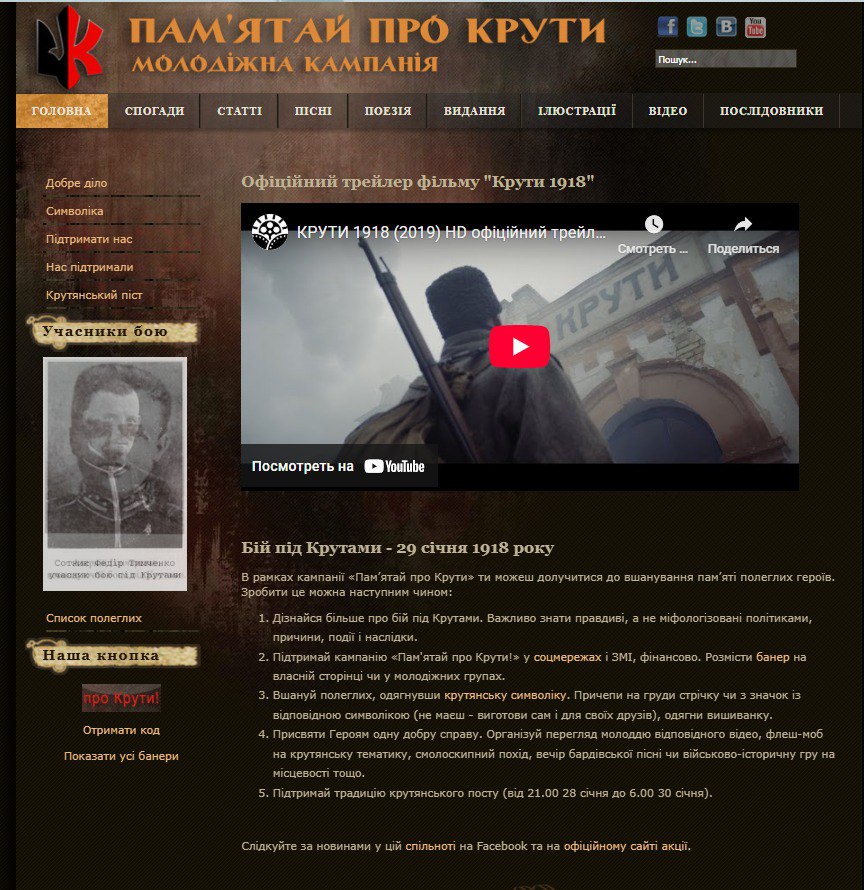

On 29 January 2026, lecturers of the Subject Committee for Social Sciences and Humanities M. V. Dzhabrailov, M. V. Khrulov, R. I. Spirzhenko and others, led by Deputy Director for Educational and Extracurricular Work Tetiana Kopaihorodska, held educational events dedicated to the anniversary of the Battle of Kruty, which took place on 29 January 1918 near Kruty railway station, close to the village of Kruty and the village of Pamiatne, 130 kilometres north-east of Kyiv and 18 km east of Nizhyn.
This battle lasted 5 hours between a 4,000-strong Red Guard unit led by the Socialist Revolutionary Mykhailo Muravyov and a detachment of Kyiv cadets and Cossacks of the “Free Cossacks”, which numbered about four hundred soldiers in total.
The Battle of Kruty began at nine o'clock in the morning on 29 January with a clash between the defenders and an advance detachment of sailors who tried to take the station in a single assault. The Bolsheviks had a considerable numerical advantage, and their three-thousand-strong detachment tried to encircle the defenders. From the rear, the Kruty defenders were supported by an armoured train with a gun, which shelled the attackers.
The defenders suffered heavy losses but managed to repel the enemy's first attacks. Then the ammunition began to run out, and the gun also fell silent, having fired off all its shells. They requested support but received no reply from headquarters. As it later turned out, the staff officers had abandoned the soldiers to their fate, fleeing back to Kyiv by train. They were in such a hurry that they even forgot to uncouple the wagons with ammunition…
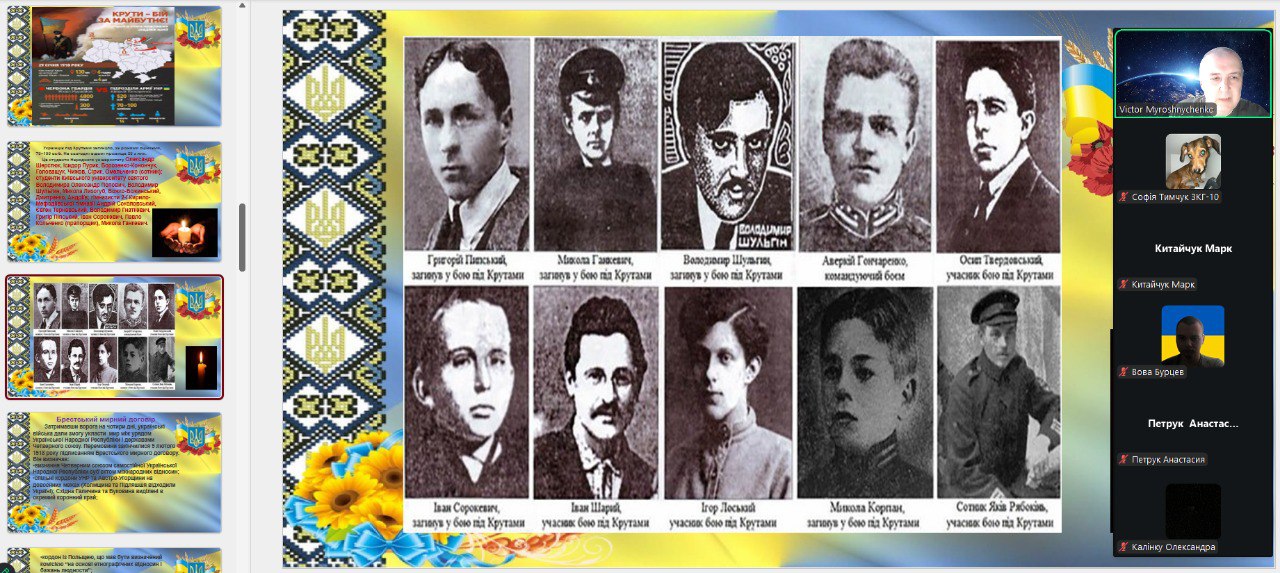
At about 5 p.m., the scattered units of the defenders gathered together. It turned out that one platoon was missing. A reconnaissance detachment of about 30 soldiers had lost its bearings and been taken prisoner. According to eyewitnesses, the “Reds” cruelly abused the prisoners and then shot them all. On the way to the execution, Hryhorii Pipskyi, a seventh-grade pupil, began to sing “Ukraine Has Not Yet Perished”, and the rest joined him.
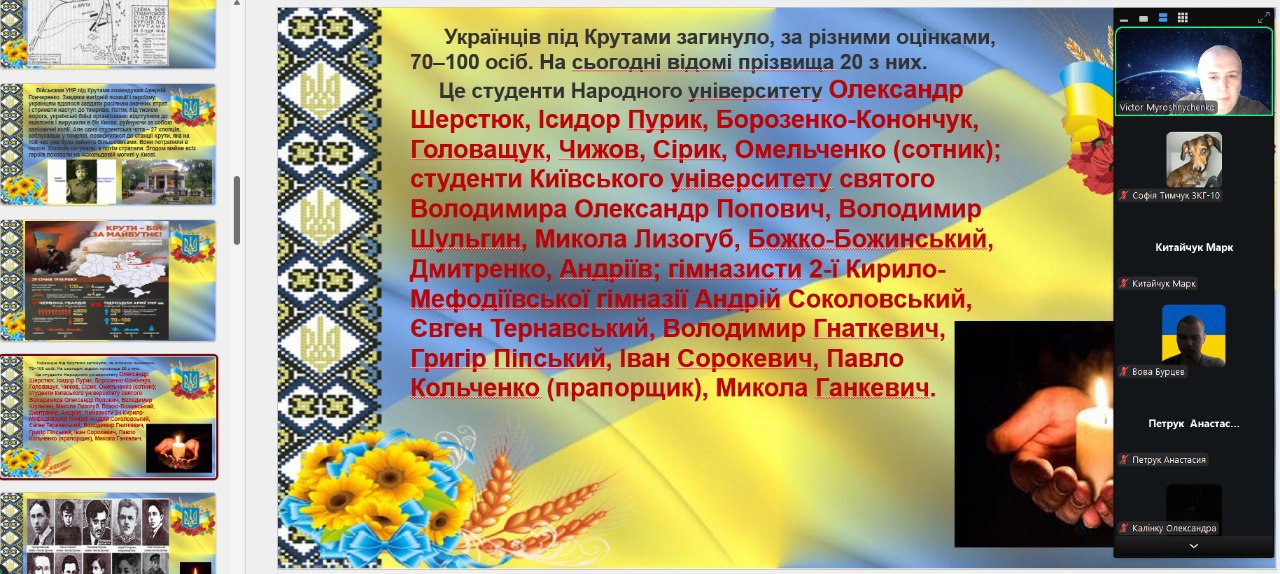
According to various sources, the Ukrainian side lost between 300 and 400 men killed, but managed to hold up the Bolshevik army and carried out an organised retreat, destroying tracks and bridges behind it. The Russian Soviet troops lost their combat capability for four days. Muravyov's forces had to resume their advance on Kyiv not by rail, as planned, but on requisitioned peasant carts drawn by horses, along a road turned to mud.
This delay of the enemy enabled the Ukrainian delegation to conclude the Treaty of Brest-Litovsk, which saved the young Ukrainian statehood.
At the funeral in Kyiv near Askold's Grave, Mykhailo Hrushevskyi, Head of the Ukrainian Central Rada, called the young men who died in the unequal struggle heroes, and the poet Pavlo Tychyna dedicated to the heroic deed the poem “In Memory of the Thirty”.